

WHEN THE SCALES TIP: HOW INEQUALITY HAS SPARKED REVOLUTIONS THROUGH HISTORY
This blog is just an opinion blog, based on the rising inequality I see around me. I am talking about the 1% of elites versus the 99% others. As for the most recent data from Credit Suisse’s Global Wealth Report (2023) and UBS, the global threshold to be in the top 1% of wealth holders is approximately: $1.2 million USD in net worth. This means that to be counted among the top 1% of the world’s adults in terms of wealth (not income), your total assets minus liabilities (net worth) must exceed $1.2 million. By some standards, this is not rich anymore, so let’s go a bit further, and focus on the top 1% of that 1%, the multi-millionaires and billionaires.
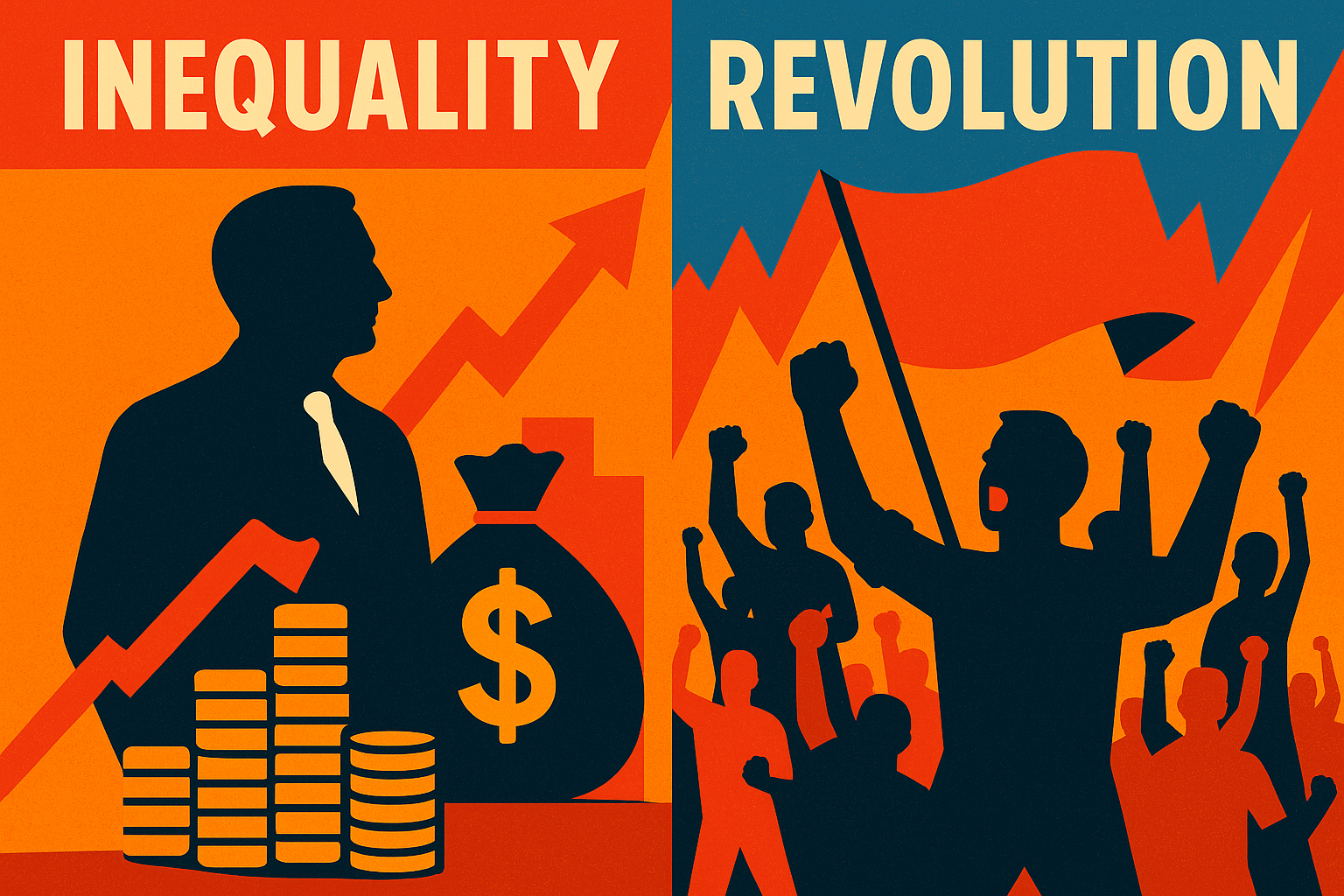
Take a good look around. The rich aren’t just getting richer; they’re doing it with a champagne glass in one hand and a lobbying contract in the other. Private jets fill the skies, luxury condos sit empty in cities with housing crises, and CEOs earn more in an hour than their workers make in a year. And the best part? They’re not even pretending to feel bad about it anymore.
We’re living in a time where wealth isn’t just concentrated, it’s flaunted. Hedge fund managers buy politicians like baseball cards, tech billionaires moonlight as policy advisors, and corporate boards hand out golden parachutes while slashing jobs. The elites are no longer hiding in boardrooms; they’re livestreaming from their yachts.
Meanwhile, the rest are told to work harder, hustle more, and stop complaining. Can’t afford rent? That’s a personal failure. Lost your job to automation? Innovate yourself. Falling behind? Pull up those bootstraps, never mind they were cut off years ago.
But here’s the thing: this isn’t new. History has seen this movie before, and it never ends quietly.
So, buckle up. Because when inequality reaches a boiling point, the system doesn’t bend, it breaks.
What happens when too much wealth sits in the hands of too few, while everyone else struggles to get by?
Karl Marx had an answer: Revolution. More than 150 years ago, Marx and Engels famously declared in The Communist Manifesto (1848):
“The history of all hitherto existing society is the history of class struggles.”
It’s a dramatic claim, but is it true?
History, as it turns out, offers some compelling evidence. When inequality reaches extreme levels and people feel shut out of opportunity and power, societies tend to get restless. And sometimes, they explode.
The French Revolution: When Cake Won’t Cut It
Let’s rewind to France in the late 1700s. The nobility and clergy lived lives of luxury while the commoners, known as the Third Estate, paid all the taxes, ate stale bread, and watched grain prices soar. France wasn’t just poor, it was unfair.
“When the people shall have nothing more to eat, they will eat the rich.” Attributed to Rousseau, echoed in revolutionary chants
The result? One of the most iconic revolutions in world history. Heads rolled, palaces burned, and France restructured its entire society. As economist Thomas Piketty writes in Capital in the 21st Century (2014), wealth inequality had become so extreme that the system had no choice but to collapse. And this wasn’t just a French problem.
Russia 1917: From Tsars to Bolsheviks
Fast forward to early 20th-century Russia, where landowners and royals still lived like medieval lords while peasants toiled in misery. Add a losing war and a food crisis, and you’ve got a perfect revolutionary cocktail.
Vladimir Lenin, a devoted reader of Marx, put theory into action. The Bolsheviks overthrew the Tsarist regime in 1917 with promises of bread, peace, and land reform.
“The state is a product of the irreconcilability of class antagonisms.” Karl Marx, paraphrased in Lenin’s The State and Revolution (1917)
According to historian Sheila Fitzpatrick (The Russian Revolution, 2008), it was mass discontent over inequality and disenfranchisement that fueled the revolution more than ideology alone.
China 1949: The Peasant Revolution
In mid-20th-century China, inequality took the form of brutal landlordism. Peasants owned little and paid dearly. When the Chinese Communist Party promised land redistribution and an end to feudal power structures, millions joined their cause.
Chairman Mao Zedong, quoting Marx and Lenin, made no secret of his views:
“A revolution is an insurrection, an act of violence by which one class overthrows another.”
Political sociologist Theda Skocpol (States and Social Revolutions, 1979) found that revolutions in France, Russia, and China all shared a common pattern:
Deep class divisions + a weakened state = revolutionary pressure.
Inequality in the Modern Era: Echoes of the Past?
Revolutions don’t always come with guillotines or Red Armies. But inequality still simmers in the streets:
The Arab Spring (2010–2012) started with a Tunisian street vendor, Mohamed Bouazizi, whose stall was shut down by corrupt police. His self-immolation sparked mass protests across the Middle East, fueled by high youth unemployment and elite corruption.
Occupy Wall Street (2011) didn’t overthrow a government, but it did give us a phrase that won’t go away: “We are the 99%.” The movement drew attention to a reality Marx would’ve recognized: growing wealth at the top, stagnation for everyone else.
But Do the Experts Agree?
Actually, yes, many of them do.
Walter Scheidel – The Great Leveler (2017)
Scheidel argues that inequality rarely disappears peacefully. Historically, it took war, revolution, state collapse, or plague to redistribute wealth.
“Inequality never dies peacefully.”
Branko Milanovic – Global Inequality (2016)
Milanovic shows that rising inequality is often followed by political polarization, populism, and sometimes violent backlash. Does this sound familiar?
Samuel Huntington – Political Order in Changing Societies (1968)
Huntington warned that when societies modernize rapidly but don’t include all citizens in that progress, revolutions are more likely, not less. The inclusion discussion?
“Revolutions are most likely not in the poorest societies, but in those where expectations rise faster than reality.”
And from the field of behavioral economics, Fehr & Schmidt (1999) found that humans are hardwired to hate unfairness, even if it costs them. That may explain why people revolt even when it’s risky.
What Can We Learn from All This?
Revolutions don’t just erupt because people are poor, they erupt because people feel trapped, cheated, and powerless in a system that favors the few.
Marx wasn’t entirely right about everything, but he was dead-on about one thing:
Inequality is not just an economic issue; it’s a social time bomb.
When a small elite hoards opportunity and wealth while the majority watch their dreams slip further away, people eventually stop asking politely. They demand change. Sometimes with signs. Sometimes with fire.
We often treat inequality like it’s just a statistic on a chart. But throughout history, it’s been the spark that lit revolutions, overturned empires, and reshaped the world. It happens often, so the question is do we learn from history?
So, if we want to avoid the mistakes of the past, we need to do more than grow our economies. We need to share that growth fairly.
Because when the scales tip too far, history shows us what happens next.
Sources & Further Reading
- Marx & Engels (1848). The Communist Manifesto.
- Thomas Piketty (2014). Capital in the 21st Century.
- Sheila Fitzpatrick (2008). The Russian Revolution.
- Theda Skocpol (1979). States and Social Revolutions.
- Walter Scheidel (2017). The Great Leveler.
- Branko Milanovic (2016). Global Inequality.
- Samuel Huntington (1968). Political Order in Changing Societies.

Dieudonne (Neetje) van der Veen is a financial and management business advisor. His work and experience are mainly in the field of financial management and structuring of companies in distress and Governance on Planning & Control cycles.
Mr. van der Veen has a master’s degree in business economics (Erasmus University Rotterdam), is a Registered Accountant (Royal Dutch Professional Organization of Accountants), CFE (Certified Fraud Examiner) and CICA (Certified Internal Control Auditor).